

Summary
- A restriction on energy exports, particularly diesel, may result in a modest short-term reduction in prices by forcing refiners to shift sales to lower-paying domestic customers.
- Lighthouse Energy Institute’s (LEI) review of analyses on energy export restrictions finds that such policies are on net economically harmful. Additionally, anticipated price reductions to end-use customers often fail to materialize because other factors (e.g., competition with foreign imports, infrastructure scarcity) mean domestic producers are not insulated from global markets.
- An export restriction may have unintended long-term negative economic effects, including by signaling to potential market entrants that future opportunities for profit may not be capitalized on because of government interventions. This may suppress diesel supply investment and increase long-term prices.
Theoretical Economic Effects
In theory, policies that restrict energy exports—such as currently debated restrictions on diesel exports—would reduce domestic energy prices in the short term and increase prices in the long term by suppressing domestic supply incentive. Prices are a function of supply and demand. A policy that limits demand—such as an export restriction that limits demand to domestic sources—would theoretically reduce domestic prices. While this may seem like an effective policy to reduce prices, it may not ultimately be successful and could bring significant cost. Limiting the number of buyers a firm may sell to reduces that firm’s profitability. That has indirect negative effects economically, such as lower wages and investment. The theoretical net effect would be negative, as the policy intervention results in a less efficient allocation of capital. A policymaker may hope to insulate consumers from elevated prices. In practice, however, economic literature—explained below—finds that such policies often have lower benefits and higher costs than anticipated.
Key Literature on Energy Export Prohibitions
There are two significant historical examples of energy export restrictions in the United States. The first is the crude oil export ban (COEB), which was put in place by the Energy Policy and Conservation Act of 1975 until 2015. The second is the required federal approval of liquefied natural gas (LNG) exports to nations without a free-trade agreement with the United States, which is still in effect. It is worth noting that these policies are not perfect corollaries to a potential restriction on diesel exports but do still offer valuable insights.
During the COEB, the domestic crude oil price—benchmarked to West Texas Intermediate (WTI)—typically traded close to the European benchmark of Brent.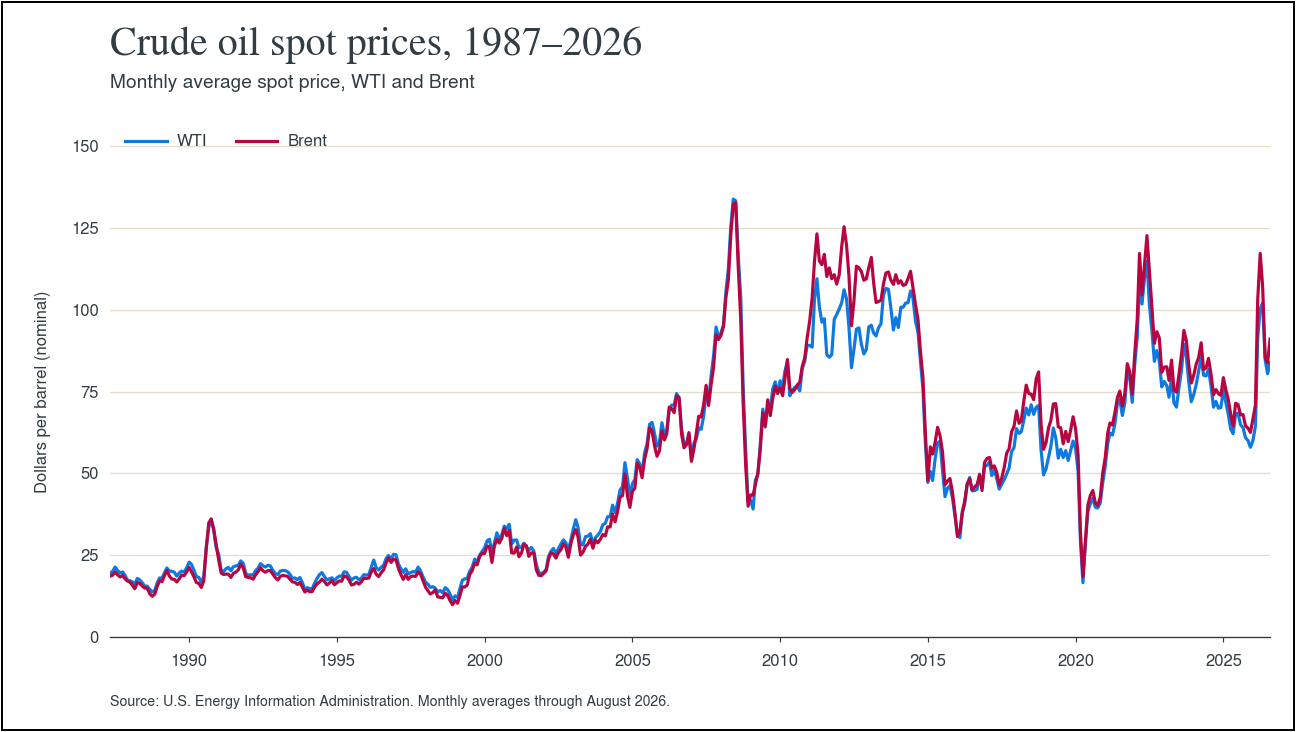
Source: U.S. Energy Information Administration, crude oil spot price history
While it may seem that this differential was caused by the COEB, a 2019 paper published in The Energy Journal found that infrastructure limitations were a significant reason for the price difference. In their estimate, internal pipeline constraints were a better explainer of the WTI “discount” than export limitations, given the discrepancy between prices from refiners relying on foreign oil versus domestic.
Also importantly, modeling from the U.S. Energy Information Administration (EIA) in 2015 on the effects of lifting the COEB found that there would be negligible changes in consumer-grade fuels because refined product prices for retail sale were largely determined by global markets, of which domestic production is only a fraction.
Similarly, other governmental analysis from the U.S. Government Accountability Office (GAO) found that lifting the COEB could potentially reduce domestic customer fuel prices. This was theorized because increased supply in the international market from enabling exports would lead to lower global prices, to which domestic refiners were pegged to.
A 2020 ex post analysis from the GAO on the effect of lifting the COEB in 2015 found that domestic customers saw essentially no price increase, challenging the idea that the COEB had any material price benefit for domestic customers.
With respect to LNG exports, the EIA modeled export increases that would occur from lifting restrictions in 2014. Their analysis found that domestic natural gas prices would increase by 4%–11% but increased domestic natural gas production responding to higher prices would cover 61%–84% of the higher demand. Additionally, residential customers would respond to higher prices by reducing consumption, and end-use natural gas bills would increase by 1%–8%. Importantly, U.S. GDP was projected to increase by 0.05%–0.17%, due to exports, indicating that policies limiting exports result in a weaker economy.
Simply, the EIA found that even though prices would increase, total energy expenditures would not match the price increase, and the negative economic effects of higher domestic energy costs would be outweighed by the increased economic production from exports.
LEI Analysis
The literature reveals that the surface-level economic theory of restricting the number of customers to insulate domestic consumers from higher prices is challenged by the facts on the ground. Market consumption and production decisions are multifaceted, so any restriction on exports can only impact a fraction of what determines the price an end-use customer pays. Interestingly, while it is expected that export restrictions would on net reduce GDP—as noted in EIA’s analysis of LNG export restrictions—there is also evidence that hoped-for price reductions may not materialize. The studies published in The Energy Journal and by the GAO explain that other factors impacting price formation can overtake the marginal benefit of reduced demand that an export restriction brings.
A diesel export ban specifically is different from a crude oil or LNG one, as diesel is a finished product for retail sale. This makes it difficult to determine to what extent an export restriction may stymie price increases, because historical examples of energy export restrictions usually impact upstream producers that can more easily pass costs downstream. That said, currently elevated diesel prices reflect both challenged global supply and domestic refinery scarcity (U.S. refineries are currently operating at 96.5% capacity, essentially maximum capacity). An export prohibition can only reduce prices to the extent that it eliminates the opportunity for a foreign customer to pay a higher price. Given that high diesel prices are currently a global phenomenon, export restriction policies may have less impact as the United States does not seem to enjoy any significant discount on diesel prices compared to the rest of the world.
The available analysis on energy export restrictions we evaluated show that such policies are on net economically harmful. Any reduced domestic energy costs would be outweighed by the lost income from the missed opportunity to sell to higher-paying foreign customers. The same policies that aim to reduce prices by limiting profit opportunities also signal to diesel producers that there is less potential for worthwhile investments. This means such policies can, perhaps ironically, raise prices in the long run by diminishing investments in production. That is true even for temporary policies, as they signal to industry that their most profitable periods of operation may be disrupted.
On net, we expect that a diesel export prohibition would result in a short-lived and small price reduction as domestic refiners sell off stocks that they had otherwise planned to export. It should also be appreciated that refinery outputs are difficult to rapidly change, and a petroleum industry trade association asserts that reduced diesel demand may encourage refiners to limit operations, the effect of which would be to reduce the supply of other refinery outputs (e.g., gasoline) and likely raise their prices.
While a diesel export ban may reduce diesel prices in the short term, it would erode the incentives for productivity and result in higher prices in the long term. While we acknowledge that higher diesel prices raise input costs in a variety of sectors, market interventions would likely worsen outcomes for the public by diminishing the incentives for efficient capital allocation and resultant production increases.